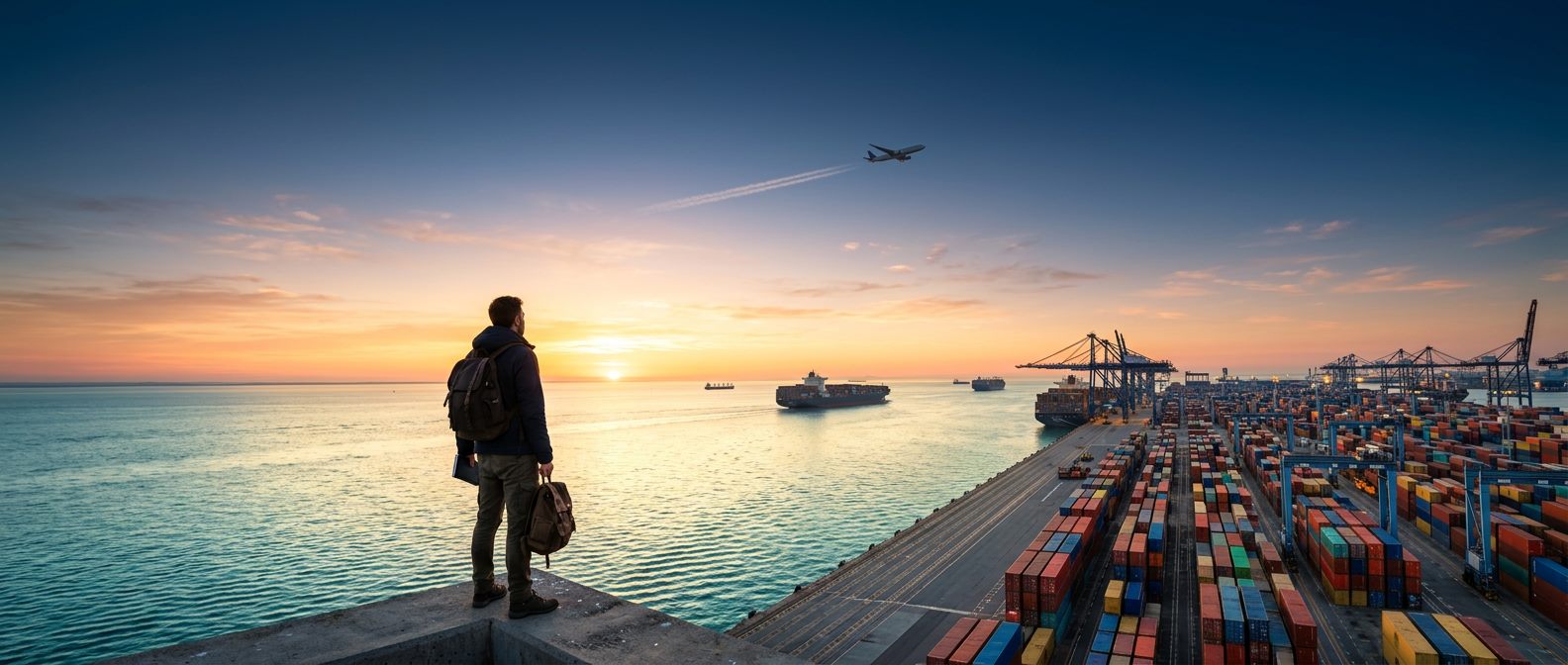
Every product ever manufactured depends on two basic functions: buying and selling. Nothing made exists without a buyer and a seller — sometimes local, often remote, always shaped by supply and demand. Getting goods from one to the other requires a route, and in global trade, we call these routes trade corridors: the pathways that keep the supply chain actually functioning.
What Is a Trade Corridor?
A trade corridor is a broader route connecting business regions with each other — cities, countries, or entire regions. These are economic pathways for global business, shaped by international trade policy, customs frameworks, and the integration of road, rail, and shipping. Accessing them properly demands real research and planning. The India-Middle East-Europe Economic Corridor (IMEC) and the International North-South Transport Corridor (INSTC) are two of the best-known examples globally.
The India-China Trade
$150 billion — that's the figure India-China trade hit in 2025, underscoring how significant China is to India's industrial demand for intermediate goods, electronics, active pharmaceutical ingredients, and heavy machinery. Imports make up the larger share of that total.
From January to June alone, trade had already reached $90 billion — roughly a 23% jump over the same period last year, with imports contributing close to $80 billion. The leading categories: electronics and electrical equipment, industrial machinery and capital goods, active pharmaceutical ingredients and organic chemicals, solar and renewable energy components, plastics and polymers, iron, steel and base metals, and niche consumer or architectural segments like luggage, sanitaryware, and bathware.
The Nepal-India-China Trade
Nepal recorded $15.7 billion in trade for the year 2082/83 BS — a significant figure given Nepal is a considerably smaller economy than either India or China. Landlocked, bordered by the Himalayas on one side and the Indian plains on the other, Nepal is a growing market for suppliers from both India (around 60% of imports) and China (around 20% and rising).
India's major exports to Nepal center on mineral fuels and oils (diesel alone over Rs 78 billion, plus petrol and LPG), industrial raw materials (crude soybean oil inputs, steel billets, iron materials), agri-commodities (rice, maize, sugar, salt), vehicles, and pharmaceuticals.
China's major exports to Nepal include electrical and tech machinery (phones, smartphones, computers), consumer electronics and appliances, ready-made garments and textiles, light industrial hardware, EVs, and transit construction equipment.
Together, the India-China-Nepal trio forms a major region of opportunity for entrepreneurs across all three countries, with India and Nepal additionally sharing close cultural ties. The trade corridors connecting them have stayed remarkably consistent, thanks to smooth cross-border movement at the India-Nepal border going back generations.
Tradeila operates directly inside this corridor of opportunity, with on-the-ground teams and physical offices across Guangzhou, Baigou, Yiwu, New Delhi, Surat, Mumbai, and Kathmandu. With 30+ years of regional experience, we're built to be the trusted partner for entrepreneurs beginning, upgrading, or scaling their global trade journey.
Signing off until next time, Tradeila – your global trade journey partner GLOBAL TRADE WITHOUT BARRIERS