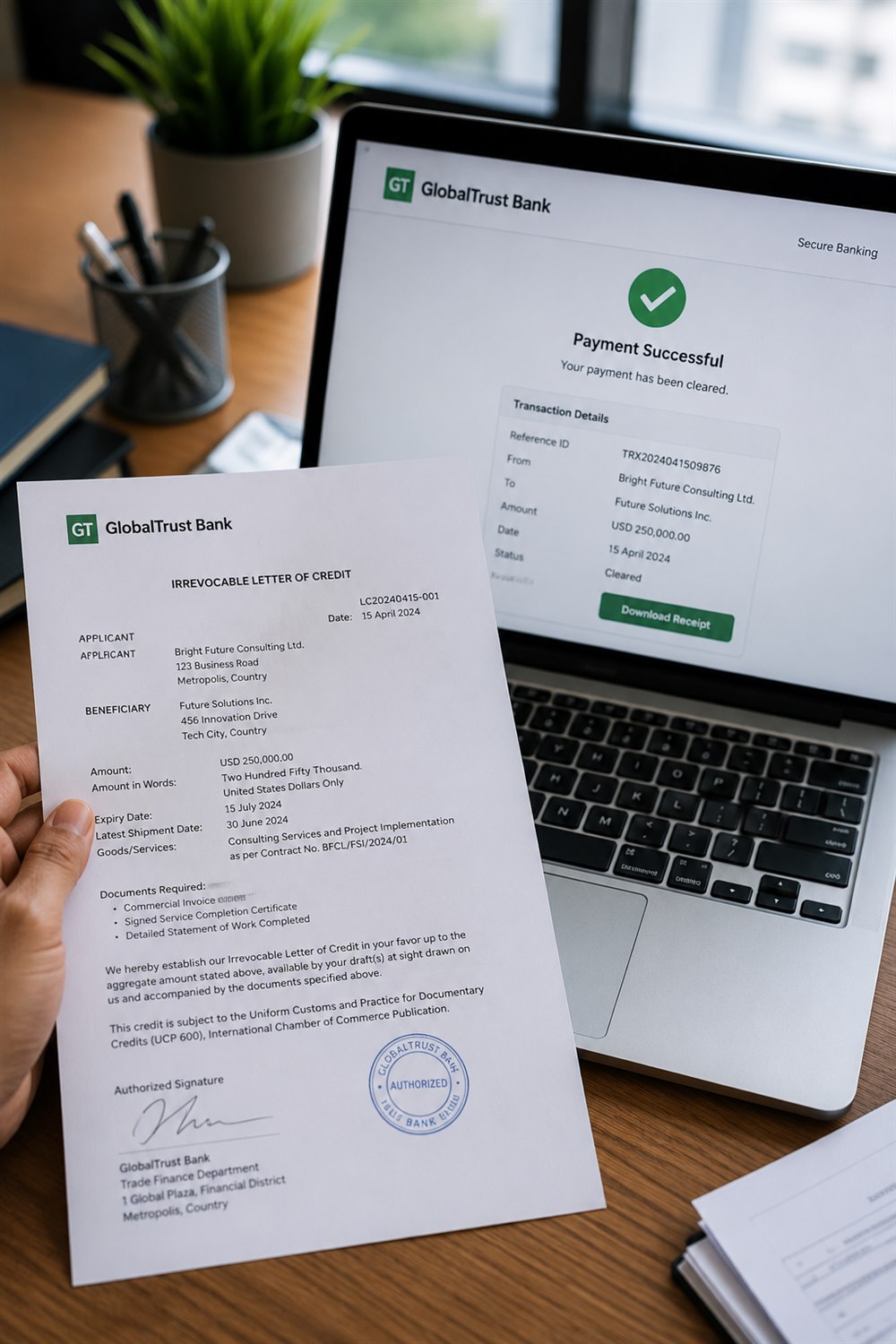
Few phrases make a first-time exporter more nervous than 'we'll need a Letter of Credit.' It sounds like a wall of paperwork standing between you and getting paid. In reality, it's the opposite — it exists to make sure you do get paid, even by a buyer you've never worked with before.
Here's the plain version. A Letter of Credit, or LC, is a promise from the buyer's bank — not the buyer themselves — that you will be paid, as long as you provide the documents proving you shipped exactly what was agreed. Instead of trusting a stranger on the other side of the world, you're trusting their bank, which has far more to lose by breaking that promise.
There are a small number of roles worth actually knowing, because confusing them is where first-time exporters get tripped up: the buyer is the applicant, you as the seller are the beneficiary, the buyer's bank that makes the payment promise is the issuing bank, and there's often an advising bank in your own country that authenticates the LC and passes it to you — sometimes going a step further to become a confirming bank, which adds its own guarantee on top of the issuing bank's, giving you an extra layer of protection if you're dealing with a buyer's bank you don't fully trust yet.
Where LCs actually go wrong is not fraud — it's paperwork mismatches. Under the international rulebook that governs these transactions (UCP 600), the bank is only required to pay if your documents match the LC's terms exactly — the right invoice, the right bill of lading, the right certificate of origin, presented within the agreed window. A single mismatched date or a product description worded slightly differently than the LC specifies can delay payment, even when the shipment itself was perfect. This is why "discrepancies" are shockingly common among first-time exporters, and almost always avoidable with the right documentation discipline from day one.
One current industry note worth knowing: international banking bodies reviewed the LC rulebook again in 2026 and chose continuity over an overhaul — meaning the fundamentals here are stable and worth learning properly, not a moving target. The live area of development is "hybrid presentation," where paper and electronic documents are submitted together, which is increasingly where banks want extra clarity agreed upfront.
The honest takeaway: an LC is genuinely one of the safest ways to get paid in international trade — it's the execution that trips people up, not the concept. Getting the documentation right, every time, is precisely the unglamorous, detail-obsessed work that separates smooth export experiences from stressful ones.
This is exactly why Tradeila built trade documentation into our own end-to-end process rather than treating it as a step you handle alone — because the difference between a paid invoice and a delayed one usually comes down to details most exporters have never had a reason to learn until it costs them.
Signing off until next time, Tradeila – your global trade journey partner GLOBAL TRADE WITHOUT BARRIERS